Adapted for our newsletter from Chinonso Godwin Okoyeaniche’s article in Professional Safety (August 2026).
Most organizations can point to a written safety program, annual training, recordable-injury tracking, and audits that keep the regulators satisfied. On paper, that looks like a functioning safety management system (SMS). In practice, it often describes a system that only wakes up after something goes wrong.
If that sounds familiar, it should — we explored a closely related idea in our recent post, The Tale of Two Stories: Why Your EHS Dashboards Might Be Hiding the Truth, where the numbers on a dashboard can tell one, reassuring story while a very different one unfolds on the floor. Okoyeaniche’s recent article picks up the same thread: meeting the legal minimum is not the same as preventing serious harm. A system built mostly around incident rates, investigations, and post-event corrective actions is a reactive one — and reactive systems have a blind spot that no amount of extra paperwork can close.
The problem with “no injuries this month”
When success is defined as the absence of injuries, a quiet month starts to look like proof that everything is working. The trouble is that a low injury rate can just as easily mask degraded controls, growing operational pressure, or hazards that haven’t produced a loss yet. Lagging indicators tell you what already happened, not what’s about to.
Reactive systems tend to share a few familiar habits: audits scheduled around the regulatory calendar rather than actual risk, near misses that go unreported, safety treated as the safety department’s job rather than everyone’s, and investigations that stop at “the worker made a mistake” without asking why the mistake made sense at the time. The result is repeated incidents with the same root causes and a workforce positioned as rule-followers rather than a source of risk intelligence.
None of this means investigation or compliance is useless — they’re essential. The point is that they can’t be the wholesystem.
What an advanced system looks like
Advancing an SMS isn’t about more documentation, more audits, or more training cycles. It’s a shift in mindset: from measuring safety by injuries avoided to measuring it by the organization’s ability to spot and control risk before harm occurs. A mature system behaves like a living thing — it adapts to change, learns continuously, and treats safety as part of how work gets planned and done rather than a parallel function bolted on the side.
The article highlights several moments where this shift matters most, because they’re periods of elevated risk that reactive systems tend to sail through on autopilot: leadership transitions and restructuring, operational or process changes, and onboarding new or transitioning workers. In each case, controls that worked under the old conditions may quietly stop fitting the new reality — and that’s exactly when frontline input and structured risk review earn their keep.
Five practical moves
Drawing on Wachter and Yorio’s research, the article lays out five concrete ways to advance a system:
- Reframe safety as risk management. Shift the framing from “injury prevention” to identifying, assessing, and controlling hazards up front. Map the critical tasks where failure could cause a serious injury or fatality, and prioritize by severity and exposure — not just how often something happens.
- Operationalize leading indicators. Track measures that are observable, actionable, and tied to risk: the quality of a lockout/tagout verification rather than the number of procedures written, the completeness of pre-task risk assessments for non-routine work, and how quickly identified hazards actually get fixed.
- Build safety into everyday work. Fold safety checks into standard work instructions, use shift handovers to surface abnormal conditions, and empower supervisors to pause work based on risk — not just after someone’s been hurt. When safety is part of the workflow, compliance becomes a by-product instead of a constant push.
- Strengthen frontline participation. The people doing the work understand its real-world variability better than any procedure captures. Give them near-miss reporting that emphasizes learning over blame, involve them in job safety analysis and control selection, and close the loop so they can see their input producing visible change.
- Move from blame to system learning. Investigate to understand why an action made sense to the worker at the time. Examine workload, time pressure, and resource constraints; look for gaps between the written procedure and how the job is actually done; and use trend analysis to catch weak signals before they become serious events.
Expect some friction
Moving beyond a reactive posture usually runs into limited leadership buy-in, competing production priorities, and plain cultural inertia. The article’s advice is pragmatic: frame safety improvements in terms of operational reliability and business continuity, pilot new approaches in high-risk areas before scaling, and train supervisors in risk-based decision-making rather than pure rule enforcement. Progress doesn’t require perfection — incremental change adds up to meaningful risk reduction over time.
Key takeaways
- Absence of injury is not proof of safety. Lagging indicators can hide serious, unaddressed risk.
- Advancement is a mindset shift, not more paperwork. Aim to control risk before harm, not just document it after.
- Watch the transition points. Leadership change, process modifications, and onboarding are high-risk windows worth deliberate attention.
- Leading indicators should measure quality, not activity counts. How well a control works beats how many procedures exist.
- Frontline workers are partners, not just rule-followers. Their knowledge is real-time system intelligence you can’t get elsewhere.
- Learn from systems, not just mistakes. Investigate the conditions around a decision, not only the individual who made it.
- Start small. Pilot, show the operational benefit, and build from there.
The bottom line: organizations that move past compliance toward practical, system-focused safety are far better positioned to prevent serious injuries and fatalities, keep operations reliable, and protect both their people and their value.
References
Dekker, S. (2014). The field guide to understanding “human error” (3rd ed.). CRC Press. https://doi.org/10.1201/9781317031833
Hollnagel, E. (2014). Safety-I and Safety-II: The past and future of safety management. CRC Press.
Hollnagel, E., Woods, D.D. & Leveson, N. (2006). Resilience engineering: Concepts and precepts. CRC Press.
Hopkins, A. (2006). Studying organisational cultures and their effects on safety. Safety Science, 44(10), 875–889. https://doi.org/10.1016/j.ssci.2006.05.005
International Organization for Standardization (ISO). (2018). Occupational health and safety management systems—Requirements with guidance for use (ISO 45001:2018).
Manuele, F.A. (2013). On the practice of safety. Wiley.
Manuele, F.A. (2014). Advanced safety management: Focusing on Z10 and serious injury prevention (2nd ed.). Wiley.
Reason, J. (1997). Managing the risks of organizational accidents. Routledge.
Reason, J. (2000). Human error: Models and management. BMJ, 320(7237), 768–770. https://doi.org/10.1136/bmj.320.7237.768
Wachter, J.K. & Yorio, P.L. (2014). A system of safety management practices and worker engagement for reducing and preventing accidents: An empirical and theoretical investigation. Accident Analysis & Prevention, 68, 117–130. https://doi.org/10.1016/j.aap.2013.07.029
Zwetsloot, G.I.J.M., Aaltonen, M., Wybo, J.-L., Saari, J., Kines, P. & De Beeck, R.O. (2013). The case for research into the zero accident vision. Safety Science, 58, 41–48. https://doi.org/10.1016/j.ssci.2013.01.026
Source article: Okoyeaniche, C.G. (2026, Aug.). A practical approach for advancing safety management systems. Professional Safety, 71(8), 25–29.
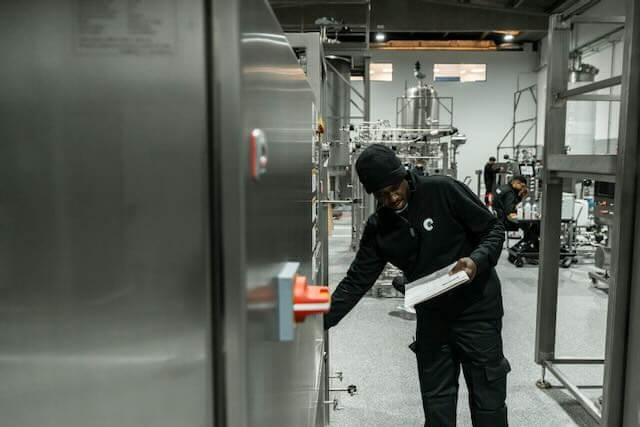
Photo by TECNIC Bioprocess Solutions on Unsplash