Don’t Let Nitrogen Be the Silent Threat in the Room: Why Nitrogen is More Dangerous Than You Think!
Nitrogen (N2) has many uses and is quite commonly used in a variety of industries. Nitrogen is a diatomic, colorless, odorless, and tasteless gas. It is chemically inert under ambient conditions, non-flammable, and does not react with most common materials.
These properties make it widely used as a blanketing, purging, and process gas in industrial and laboratory settings. However, these same properties — particularly its inertness and its ability to displace oxygen — make it a significant asphyxiation hazard when released in quantity in an enclosed or semi-enclosed environment.
Nitrogen is classified as a simple asphyxiant by OSHA. It is not intrinsically toxic to the human body at the concentrations encountered in oxygen-deficient atmospheres. Nitrogen does not react with biological tissues, does not inhibit enzymatic processes, and is not absorbed into the bloodstream in a pharmacologically active form under normal conditions.
Nitrogen displaces oxygen in the ambient air, reducing the partial pressure of oxygen (pO₂) available for respiration. Human physiology is highly sensitive to reductions in oxygen. OSHA defines an oxygen-deficient atmosphere as any atmosphere containing less than 19.5% oxygen by volume. Oxygen is normally found in the atmosphere between 19.5% and 23.5%. Reductions in oxygen below 19.5% cause measurable physiological effects, and severe reductions cause rapid loss of consciousness and death without warning.
The physiological response to oxygen deficiency is not perceived as suffocation — a person in a nitrogen-enriched, oxygen-deficient atmosphere may simply feel mildly dizzy and then lose consciousness, without any sensation of breathing difficulty. This characteristic makes nitrogen asphyxiation hazards among the most deceptive in industrial settings. 19.5% serves as the primary regulatory threshold used throughout this analysis.
When gaseous nitrogen escapes from a pressurized system — whether through a leak, a failed fitting, or a pressure relief device — it expands and mixes into the surrounding air quickly. Because nitrogen gas weighs almost the same as air, it does not reliably float up to the ceiling or sink to the floor on its own. In practice, air currents, ventilation systems, and the force of the release itself will push nitrogen in whatever direction conditions dictate.
It cannot be assumed that a nitrogen release will dissipate to a safe location. In any enclosed or partially enclosed space, a gas release of meaningful size can reduce the oxygen level in the breathing zone to dangerous levels within minutes, particularly in areas with poor ventilation, dead-air corners, pits, or trenches.
Liquid nitrogen (LN₂) is a far more serious hazard than gaseous nitrogen upon release, and the difference comes down to one critical fact: liquid nitrogen boils instantly when it contacts anything at room temperature, and as it boils it expands to roughly 700 times its original volume as a gas.
As a practical illustration, a single gallon of liquid nitrogen spilled on the floor will produce enough gaseous nitrogen to fill a small room. Beyond the sheer volume of gas produced, the nitrogen that boils off a liquid spill is initially extremely cold and therefore heavier than the surrounding air. This means it will hug the floor and accumulate in low-lying areas — exactly where people are breathing — before it eventually warms up and disperses.
A liquid nitrogen release will also produce a visible white cloud of condensed moisture in the air, which may look like the entire hazard zone, but the actual oxygen-deficient atmosphere extends invisibly beyond that cloud as the gas warms and spreads. A liquid nitrogen release creates a larger hazard zone, faster, at floor level, with less visible warning than a gaseous nitrogen release of the same size.
Want to ensure your facility is truly protected? Don’t wait for an incident to find the gaps in your safety protocols. Download our comprehensive technical guide below, or reach out to Dimensions Consulting today to schedule a formal workspace hazard assessment.
Downloadable White Paper (Downloadable PDF) : Analyzing and Mitigating the Asphyxiation Hazards of Gaseous and Cryogenic Nitrogen (N2) in Industrial Environments
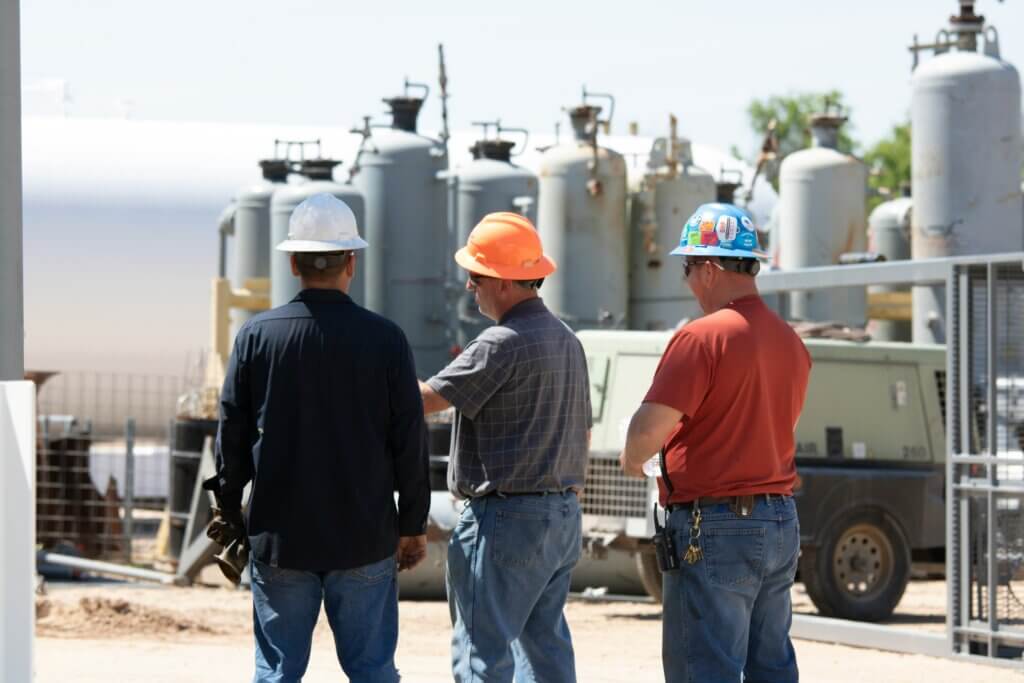
Photo by Christina Hawkins on Unsplash