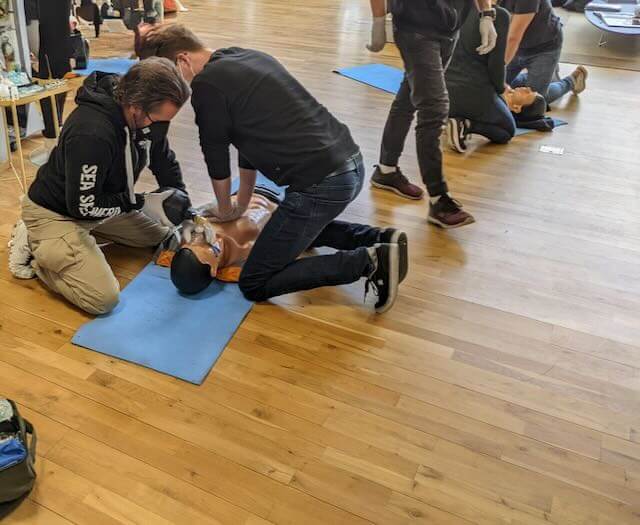
Keeping your workforce safe means managing risk before it becomes a tragedy. Many companies diligently schedule First Aid and CPR/AED trainings. We track certification cards, file them away, and set a calendar reminder for 24 months down the road to schedule recertification trainings.
Ask yourself: If an employee collapses on day 400 of that 730-day certification cycle, are your employees actually ready to save their life? Are you doing what you need to do to protect your team?
The hard truth is that an unpracticed skill is a deteriorating skill. When it comes to performing under the massive physiological stress of an emergency, a two-year gap in practice is a recipe for hesitation, poor technique, and ultimately failure.
The Legal Baseline: Providing a Safe Workplace
From a strictly legal and regulatory standpoint, employers are bound by the general duty to provide a workplace free from recognized hazards. In the United States, OSHA’s standard 1910.151 (Medical Services and First Aid) requires that in the absence of an infirmary, clinic, or hospital in near proximity to the workplace, a person or persons must be adequately trained to render first aid.
Industry standard dictates that these certifications are valid for 2 years. For many organizations, hitting that two-year mark satisfies the legal requirement. The box is checked, liability is theoretically minimized, and compliance is achieved.
However, regulatory compliance is the absolute minimum standard of care. The law requires you to have trained personnel, but the spirit of the law requires that training to be effective when it matters most. The same principles apply to all safety training from Haz Com and Chemical Safe Handling to Lockout Tagout and Fall Protection. Training cannot be a checkbox but the learning and behaviors must be transferred to day-to-day work activities.
The Kinesthetics of Lifesaving: Why Mastery Requires Movement
To understand why a two-year certification cycle fails the responder, we have to look at the kinesthetics of emergency response—how the body learns, stores, and recalls physical movement. For example:
Performing high-quality CPR is a complex motor skill. It requires specific hand placement, a rigid upper body posture, locking the elbows, and driving downward at least 2 inches at a rate of 100 to 120 beats per minute, all while allowing for full chest recoil. Operating an AED requires fine motor skills—tearing open packages, peeling adhesive pads, and placing them accurately on a sweaty or hairy chest.
In the science of motor learning, we understand that skills decay rapidly without reinforcement.
- The Forgetting Curve or Information Decay: Cognitive knowledge (remembering the compression-to-breath ratio) begins to degrade within weeks of a class.
- Motor Skill Decay: Muscle memory—the physical “feel” of a proper chest compression—decays even faster if it is not practiced.
- The Stress Response: During a sudden cardiac arrest, the responder’s sympathetic nervous system triggers a massive adrenaline dump. Fine motor skills degrade, tunnel vision sets in, and the brain relies exclusively on deeply ingrained habits.
If a responder has only learned and practiced pressing on a manikin’s chest once in the last two years, they do not have a habit. They have a faded memory. When the adrenaline hits, hesitation takes over. In cardiac arrest, every minute without CPR decreases the chance of survival by 7-10%. We cannot afford hesitation.
Bridging the Gap: Acceptable Frequency of Practice
Demonstrating a physical skill once every two years does not build mastery; it barely establishes an introduction. To move from theoretical knowledge to kinesthetic automaticity, we must change how we train.
The most effective model in modern emergency response is Low-Dose, High-Frequency (LDHF) training. In addition to the certification class every two years, First Aid and CPR skills should be reinforced in short, focused bursts.
To achieve true familiarity and readiness, MERT should participate in:
- Mental Reps (Monthly): Responders need to mentally walk through the steps of an emergency response. Visualization engages the same neural pathways as physical practice. Reinforcing learned information or delving deeper into topics already covered is a critical piece to help rescuers remember information in the heat of a rescue.
- Hands-On Refreshers (Quarterly): At least every three months, trained responders should spend time physically practicing compressions on a manikin and walking through an AED deployment. This is the minimum frequency required to prevent severe motor skill decay.
- Emergency Response Reviews: on the other months, skills for responding to injuries and medical emergencies should be reviewed and practiced.
- Scenario Integration: Incorporate brief medical response scenarios into your regular MERT trainings. Make the physical movement of grabbing the AED and First Aid kit to respond to a specific location a routine muscle memory.
Call to Action: Exceed Compliance for Excellence
As safety leaders, we must stop treating First Aid and CPR/AED certifications as an administrative checkbox and start treating them as the critical life-support systems they are.
Compliance keeps you out of the courtroom; excellence keeps your employees safe, cared for, and well.
We challenge you to look at your current OHS program. Are you training for a certificate, or are you training for an emergency? Do not let 730 days pass between practice sessions. Implement regular MERT training and skills checks. Provide opportunities for your responders to physically rehearse the movements until applying the skills feels like second nature.
Aim higher than the minimum standard. Exceed compliance, build true kinesthetic readiness, and create a culture where your employees are actually prepared to save a life today. This same standard is absolutely necessary for all of your safety programs. More on this topic soon.
Dimensions can help you build and develop a rescue-ready Medical Emergency Response Team. Contact us to talk about your MERT training and how we can help establish a rescue-ready team.
Photo by Martin Splitt on Unsplash.com