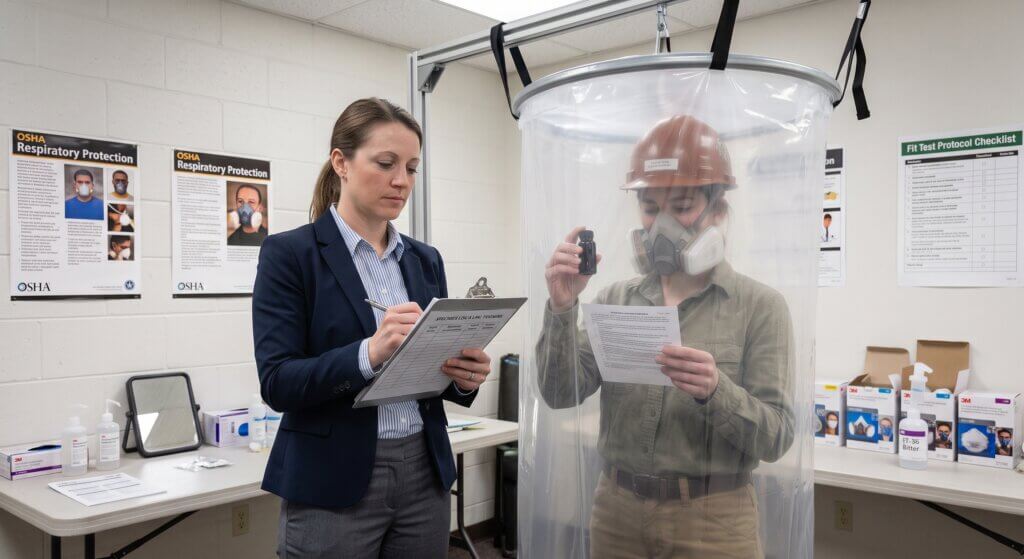
Recently a company EHS manager contacted us regarding respirator fit testing and medical clearance for identified employees. We provided a quote, and the response was that we weren’t any less expensive than the offsite clinic they currently used. We responded that it was great if the service is working well for them and they did not want to change. However, it got us thinking that there is more to cost than the direct dollar value for the service plus there are the added value of convenience and occupational health and safety expertise. Below is a summary of return on investment considerations when making a decision for respiratory protection assistance as well as other EHS services.
First as you know, OSHA’s respiratory protection standard (29 CFR 1910.134) mandates comprehensive compliance—from written plans and medical evaluations to annual fit testing and training. While compliance is mandatory, how you execute it determines your bottom line.
To demonstrate the monetary value of compliance service options to executive management, EHS leaders use the Cost-Benefit Ratio (Cost Saved ÷ Cost Spent) to determine the Return on Investment (ROI). Here is how three common delivery models compare for a company with 200 required respirator wearers.
The following examples are based on salary estimates:
- For example, the averaging employee salaries are $75,000 + 30% for benefits = $97,500. The hourly rate is: $46.88.
- Lost Productivity could be included and may be as high as 2. 5 – 3 times
the employee salary - EHS and OHN Staff: Again, for example, the staff salaries are $114,400 + 30% benefits
$148,720. Hourly rate is: $71.5.
Cost Breakdown Across Delivery Models
Option 1: Offsite External Clinic (The Highest Cost)
- Direct Clinic Fees: $32,000 ($160/employee)
- Employee Wages & Productivity Lost: $65,632 (Estimated 2 hours travel/wait/testing time + lost productivity factor)
- Total Financial Impact: $97,632
Option 2: Internal Staff Execution (The Invisible Burden)
- Employee Lost Time/Productivity: $11,720 (30 minutes clinic time)
- In-House EHS/Nursing & Admin Time: $21,300 ($106.50/employee in dedicated internal labor)
- Equipment & Setup: $1,000
- Total Financial Impact: $34,020
Option 3: Dedicated Onsite Vendor Service (The Efficient Hybrid)
- Vendor Service Fee: $32,000 (Includes all setup, testing, and paperwork)
- Employee Lost Time/Productivity: $11,720 (30 minutes per employee onsite)
- Total Financial Impact: $43,720
The ROI: Evaluating the True Gains
Internal Execution vs. Offsite Clinic
- Cost Saved: $97,632 (External) – $34,020 (Internal) = $63,612
- Cost-Benefit Ratio: $63,612 ÷ $34,020 = 1.87
- ROI Verdict: Performing testing internally yields an ROI of $1.87 saved for every $1.00 spent compared to sending workers offsite.
Onsite Vendor Service vs. Offsite Clinic
- Cost Saved: $97,632 (External Clinic) – $43,720 (Onsite Vendor) = $53,912
- Cost-Benefit Ratio: $53,912 ÷ $43,720 = 1.23
- ROI Verdict: Bringing a dedicated expert onsite yields an ROI of $1.23 saved for every $1.00 spent over offsite clinic visits.
- Internal Execution vs. Onsite Vendor (The Strategic Opportunity) While purely internal execution appears $9,700 less expensive on paper ($43,720 vendor vs. $34,020 internal), it consumes over 200 hours of internal EHS and Occupational Health Nurse (OHN) time. Outsourcing to an onsite vendor costs a minor premium while freeing up internal EHS professionals to focus on other high-value hazard mitigation and core business operations, preventing administrative burnout. It comes down to cost savings versus value of investment.
Optimize Your Respiratory Protection Program Today
Ready to save valuable EHS hours and streamline your compliance processes? Partner with Dimensions in Occupational Health and Safety. Our team provides mobile, turnkey medical clearance and fit testing solutions directly at your workplace—maximizing productivity while ensuring full OSHA compliance. We can provide both services or either one that is needed at your facility.
[Contact Dimensions] today to schedule assistance with your Respiratory Protection Program or your next health and safety program event.